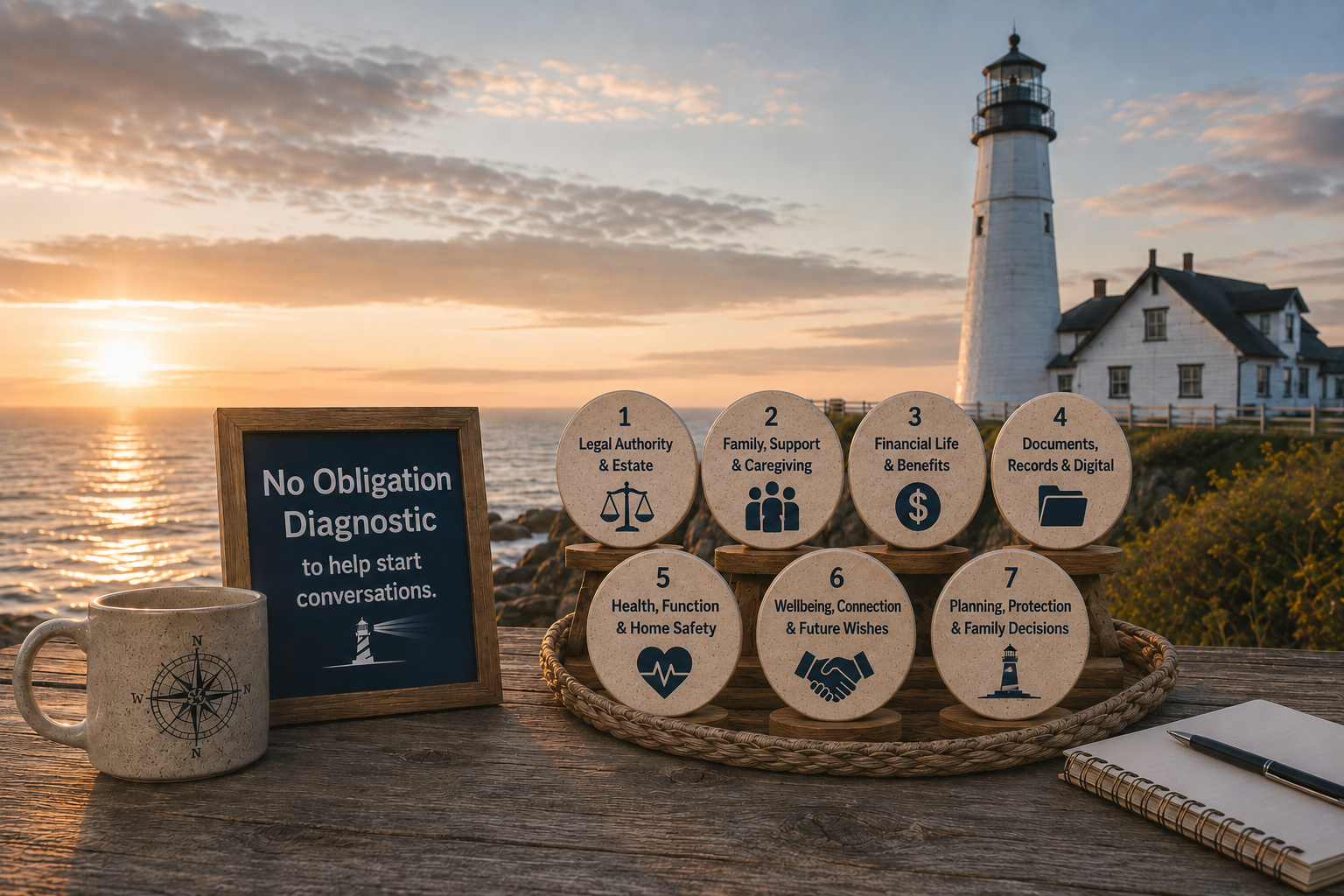
Free - No Obligation - Educational - Step 1 in Identifying Potential Gaps
Take 1, 2, or all 6 to give you, your loved one, or your client a better view of where you stand today.
Important Information & Privacy
The following assessments are designed as educational tools for personal planning and coordination purposes. They do not constitute legal, financial, medical, or clinical advice. Use of these tools does not establish a professional-client relationship. You are encouraged to review the results with your personal attorney, physician, or other professional advisors before making significant lifestyle changes.
Privacy & Security: Your data stays with you. All answers remain strictly in your browser and are not stored on our servers. Refreshing or closing this page will permanently clear your data. If you would like to keep a summary of your results, you may print out the report for your personal records. Because this report may contain information you do not want to share, please be careful with whom you choose to share the printed copy.
🗄️
Readiness
Administrative Security
"Do you know where everything is — and who can act?"
This assessment takes stock of how organized and prepared your life actually is across the areas that matter most when something unexpected happens. It looks at your legal documents, financial records, medical information, home safety, and family coordination — and shows you exactly where you're covered and where the gaps are. Think of it as a complete inventory check, not of your stuff, but of your readiness. Most people are surprised by what they're missing. Most gaps are fixable in a single afternoon once you know they exist.
›
👔
Independence
Preserved Autonomy
"Can you — or your loved one — manage daily life independently?"
This assessment measures functional capacity — the practical ability to handle the tasks of everyday life on your own. It's grounded in the same clinical tools physicians use, including the Katz Activities of Daily Living scale and the Lawton Instrumental ADL scale. It looks at everything from bathing and dressing to managing finances and medications. It's not about what you have — it's about what you can do. Understanding where support is needed before a crisis reveals it leads to better planning, better outcomes, and far less family stress.
›
🗣️
Lifestyle Priorities
Empowered Agency
"What actually matters to you in this next chapter?"
Most aging plans are built around what families and professionals think a senior needs. This assessment starts somewhere different — with what you actually want. It measures what's most important to you across independence, family connection, health, purpose, and daily life — then maps those priorities to what you should be focusing on first. The result is a plan that's grounded in your values, not someone else's checklist. It changes the conversation from "what do we need to do for you" to "what matters most to you."
›
🤝
Systemic Sustainability
Strategic Continuity
"Is the support system around your loved one sustainable?"
Caregiving is invisible until it breaks down — and when it breaks down, the person who suffers most is often the senior who depended on it. This assessment looks honestly at the caregiving structure surrounding a senior: who is carrying the load, whether that's sustainable, where the gaps are, and whether there's a plan for when things change. It's designed for the adult children, spouses, and family members who are quietly carrying an enormous weight — and who rarely get asked how they're doing.
›
🤖
AgeTech & Innovation
Modern Resilience
"Is your home and lifestyle ready for the future of care?"
Technology is often a hidden barrier until it becomes a critical lifeline. This assessment looks honestly at your current digital footprint: your comfort with everyday devices, the reliability of your home network, and your ability to navigate telehealth or wearable health trackers. But it also looks forward at your interest in the innovations just around the corner — from AI-driven social companions to robotic mobility assistants. Understanding your technology readiness today is essential to building a resilient home that can adapt to the breakthroughs of tomorrow.
›
💬
Emotional Transitions
Purposeful Continuity
"Are you — and your family — ready for the conversations that matter most?"
Most aging plans address what you have and what you can do. This assessment addresses something harder: how you feel about what's coming, and whether the people around you are prepared to navigate it with you. Grounded in the psychology of adult transitions — the work of William Bridges, Erik Erikson's framework of ego integrity and despair, and current gerontological research on anticipatory grief and family communication — it looks honestly at your emotional readiness across six domains: life acceptance, end-of-life conversations, grief and loss, family communication, cognitive decline planning, and legacy. There are no wrong answers. Most people find that naming what they haven't said is the first step to saying it.
›